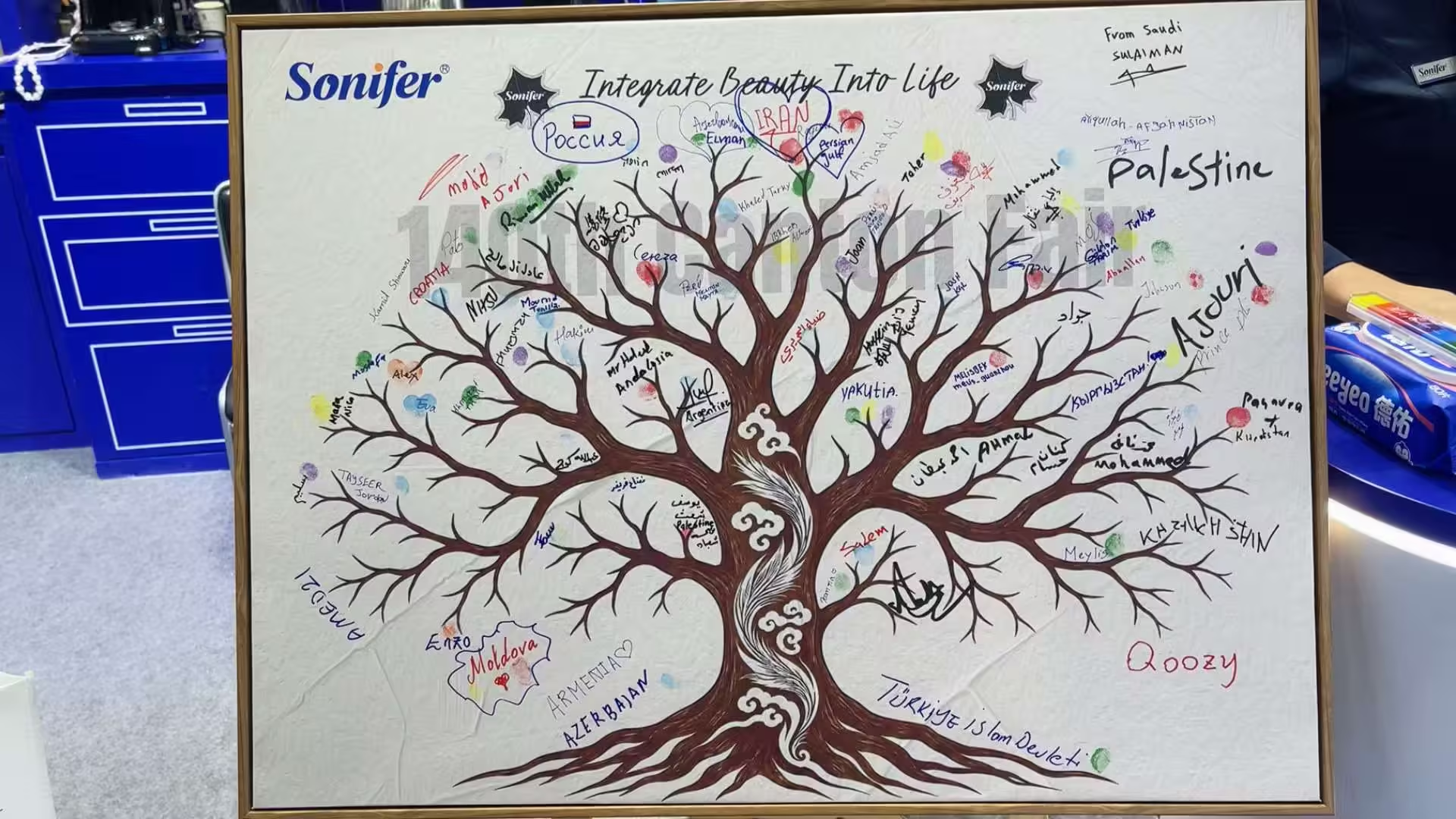


The 140th Canton Fair Phase 1 has come to an end.From October 15 to 19, Sonifer welcomed international buyers at Booth 5.1C 37–38 in Guangzhou.For exhibitors, the end of a trade fair does not mean the work is finished.In many ways, the more important work starts afterwards:Samples need to be reviewed、Specifications need to be confirmed、Quotations need to be compared、Follow-up discussions begin.
And perhaps most importantly, the conversations collected during five busy exhibition days need to be turned into useful market information.
After speaking with buyers from different markets, several observations stood out to us.
1. Buyers Are Looking Beyond the Lowest Price
Price remains an important part of international sourcing.That has not changed.What has changed is the number of factors being considered alongside price.
Buyers are increasingly asking about product functions, quality consistency, packaging, certifications, product differentiation and supply reliability.
This makes sense.A lower purchase price does not necessarily create a lower total business cost.
If a product has quality problems, unclear documentation, unsuitable packaging or inconsistent specifications, the cost can appear later in the supply chain.Professional buyers are therefore looking at value rather than price in isolation.
2. Product Functionality Needs to Be Meaningful
Another clear observation is that buyers are becoming more selective about product features.
More functions do not automatically mean a better product.The question is whether the functions are useful to the target consumer.For small appliances, usability remains fundamental.
Consumers want products that are straightforward to operate, easy to maintain and capable of delivering the expected result.This creates an interesting challenge for product development.The goal is not simply to add features.It is to identify the features that improve the actual user experience.
3. Product Differentiation Is Becoming More Important
For many buyers, the challenge is not finding a product.It is finding a product that gives them a reason to choose it over competing products.This is particularly relevant for e-commerce and highly competitive retail markets.
Design, product configuration, packaging, usability and clear product positioning can all contribute to differentiation.
However, differentiation should still have a commercial purpose.A different appearance may attract attention.A genuinely useful function can create repeat demand.The strongest products often combine both.
4. Market-Specific Requirements Cannot Be Ignored
Conversations at the exhibition also reinforced how different international markets can be.
Voltage and plug requirements are obvious examples, but the differences go much further.Packaging, language, product positioning, consumer expectations, retail channels and regulatory requirements can all influence whether a product is suitable for a particular market.
This is why international product development cannot rely entirely on a one-size-fits-all approach.Understanding the destination market before finalizing a product is becoming increasingly important.
5. Buyers Want Faster and Clearer Communication
One of the less visible trends at an exhibition is how buyers communicate with suppliers.
Buyers often arrive with product specifications, target markets and clear questions.They expect suppliers to provide accurate information rather than general sales presentations.
This is a positive development.It encourages both sides to communicate more precisely.For suppliers, it means product knowledge matters.A salesperson who understands the product can answer questions more effectively and identify issues that need technical confirmation.
6. Face-to-Face Meetings Still Have a Role
After several years of increasingly digital international sourcing, it would be easy to assume that physical trade fairs have become less important.Our experience at the 140th Canton Fair suggests otherwise.
Online communication is efficient.But physical meetings provide a different type of information.Buyers can inspect products directly.They can compare models side by side.They can see details that may not be obvious in photographs.And they can have a direct conversation with the people responsible for the product and business relationship.For complex purchasing decisions, that interaction remains valuable.
What These Conversations Mean for Sonifer
For Sonifer, the five days at the Canton Fair provided more than opportunities to introduce products.
They provided feedback.We heard what buyers are currently looking for, which product features are receiving attention, what concerns buyers have when evaluating suppliers, and where market requirements are becoming more specific.
That information is useful beyond the exhibition.It can influence how we evaluate products, how we communicate specifications, and how we think about future product opportunities.
A trade fair should therefore not be measured only by the number of business cards collected.Its longer-term value comes from what the company learns.
Looking Beyond the Exhibition
The next step is follow-up.Some conversations will develop into sample evaluations.Others will lead to quotations or further technical discussions.Some may simply remain useful market feedback.
Not every meeting needs to become an order.International business is built over time.For us, the objective is to maintain clear communication, provide accurate product information and understand what each market actually needs.
The 140th Canton Fair has ended for Phase 1.But the conversations started in Guangzhou will continue.Thank you to all buyers and industry partners who visited Sonifer at Booth 5.1C 37–38.
We look forward to continuing the discussions beyond the exhibition hall.